
Method of putting on Iḥrām
The way of putting on Iḥrām for Hajj and ‘Umraĥ is the same. However, there is a slight difference in intention and its wording.
The details of intention are described in the next pages. First note the method of putting on Iḥrām.
- 1. Trim nails.
- 2. Remove armpits’ hair and pubic hair including the hair of the rear private part.
- 3. Use Miswāk.
- 4. Make Wuḍū.
- 5. Perform Ghusl thoroughly.
- 6. Apply fragrance to the body and Iḥrām shawls as it is a Sunnaĥ but don’t use any perfume that stains clothing like dry ambergris (umber).
- 7. Removing sewn clothes, Islamic brothers should put on a piece of new or washed shawl to cover the upper body and use a similar cloth as Taĥband1 (i.e. a piece of cloth used to cover the lower part of the body).
- 8. A belt with a pocket may also be worn to keep the passport or money etc. in it. Use a nylon or leather belt with a pocket on the front as it is strong and durable. A low-quality belt may tear, causing trouble.
Iḥrām of Islamic sisters
Islamic sisters are to wear their sewn clothes as usual. They may wear socks and gloves as well. They should keep their heads covered but should not wear such a veil that touches their face. However, they may use a book or a handheld fan in order to conceal their face from non-Maḥram men, when necessary. It is Ḥarām for women to hide the face in the state of Iḥrām with such a thing that is in contact with the face.
1 Taĥband must be thick enough to prevent the skin colour to be noticed and the other cloth could be of towelling.
Nafl Ṣalāĥ of Iḥrām
If it is not a Makrūĥ time, offer two Rak’āt Nafl Ṣalāĥ with the intention of Iḥrām (men should also keep their heads covered whilst offering this Ṣalāĥ). It is better to recite Sūraĥ al-Kāfirūn and Sūraĥ al-Ikhlāṣ after Sūraĥ al-Fātiḥaĥ in the first and the second Rak’at respectively.
Intention for ‘Umraĥ
Now the Islamic brothers with their heads uncovered and the Islamic sisters with their heads covered should make the following intention of ‘Umraĥ.
Translation: Yā Allah, I make the intention of ‘Umraĥ, make it easy for me and accept it from me. Help me in performing it and make it blessed for me. I have made intention for ‘Umraĥ and put on its Iḥrām for the sake of Allah.
Labbayk
After making the intention, it is essential to recite Labbayk at least once; reciting it thrice is preferable. Labbayk is as follows:
I am in attendance. Yā AllahI am in attendance. I am in attendance (and) You have no partners. I am in attendance. No doubt, all glorification and bounties are for You and also the sovereignty (is Yours), You have no partners.
O pilgrims to Madīnaĥ! You are now in the state of Iḥrām. This Labbayk is the most important invocation for you. Recite it abundantly while sitting, standing and walking.
Entering Makkaĥ
Anyway, enter the limits of Ḥaram with your head bowed and eyes lowered with humility and shame for all the sins committed. Recite Ṣalāt-‘Alan-Nabī and Labbayk and do Żikr in abundance. As soon as you glance at the sacred city of Makka-tul-Mukarramaĥ of Rab-bul-‘Ālamīn, recite the following Du’ā:
Yā Allah! Bestow upon me peace and Ḥalāl sustenance in it.
After reaching Makka-tul-Mukarramaĥ, make arrangements for accommodation and keep luggage etc. at a safe place. Then, come to Bāb-us-Salām reciting Labbayk. Kiss the holy door and enter Masjid-ul-Ḥarām placing your right foot first and reciting the Du’ā of entering the Masjid that is as follows:
Translation: Allahin Whose name I begin and salutations on the Beloved Rasūl. Yā Allah, open the portals of Your mercy for me.
Make intention of I’tikāf
Make it a routine to make the intention of I’tikāf whenever you enter any Masjid. Also do so in Masjid-ul-Ḥarām. One good deed here is equivalent to a hundred thousand deeds performed elsewhere.
Hence one will get the reward of a hundred thousand I’tikāf. You will get the reward for as long as you stay in the Masjid. In addition, acts of eating, drinking water including Zamzam water and sleeping will also become permissible; otherwise these acts are impermissible in the Masjid according to Sharī’aĥ.
Translation: I make the intention of Sunnaĥ of I’tikāf.
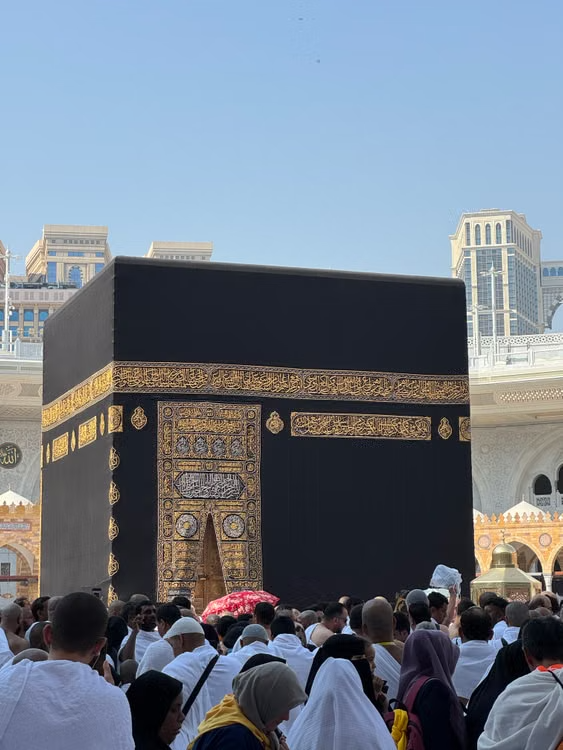
First sight at Holy Ka’baĥ
As soon as you have the first glance of the Holy Ka’baĥ, recite the following thrice:
Then, recite Ṣalāt-‘Alan-Nabī and make Du’ā as the Du’ā made on having the first glance of the Holy Ka’baĥ is definitely accepted. You may also make this Du’ā: ‘Yā Allah, whenever I make permissible Du’ā that is beneficial to me, accept it.’ ‘Allāmaĥ Shāmīhas quoted Islamic jurists to have stated: When having the first glance of the Ka’baĥ, one should make Du’ā to be blessed with entry into Paradise without accountability, and should recite Ṣalāt-‘Alan-Nabī. (Rad-dul-Muḥtār, vol. 3, pp. 575)
Most virtuous Du’ā
Respected devotees of Rasūl and seekers of the pleasure of Allah and His Prophet! Instead of reciting different specific Du’ās, it is the most virtuous act to recite Ṣalāt-‘Alan-Nabī on every occasion like during Ṭawāf, Sa’ī, etc.All of your problems will be resolved by virtue of Ṣalāt and Salām. You should do what is better than all Du’ās for you, as promised by the Holy Prophet. That is, recite Ṣalāt-‘Alan-Nabī here and on any other occasion instead of making Du’ā for you. The Prophet of Raḥmaĥ, the Intercessor of Ummaĥhas stated, ‘If you do so, Allahwill resolve all your problems and forgive all your sins.’ (Tirmiżī, vol. 4, pp. 207, Ḥadīš 2465; Fatāwā Razawiyyaĥ, vol. 10, pp. 740)
Halting for Du’ā during Ṭawāf is forbidden
Respected pilgrims! If possible, recite only Ṣalāt and Salām as it is the most virtuous invocation in addition to being easier to be recited. However, Du’ās are also given for those who are keen to recite them. But remember that whether you recite Ṣalāt and Salām or Du’ā’s, recite them in a low voice. Some Ṭawāf-performing people recite Du’ās aloud like shouting. You should avoid it. Furthermore, recite it whilst walking. Do not halt during Ṭawāf for reciting anything.
Method of Ṭawāf
Before commencing Ṭawāf, men should do Iḍṭibā’, i.e. put on the shawl by bringing its one end from under the armpit of the right hand and placing its both ends over the left shoulder such that the right shoulder remains uncovered. You are now ready for Ṭawāf of the Holy Ka’baĥ.
Now in the state of Iḍṭibā’, stand up facing the Holy Ka’baĥ such that the whole ‘Ḥajar-ul-Aswad’ will be pointing towards your right side. Now make intention1 for Ṭawāf in the following words without raising the hands:
Translation: Yā Allah! I make intention for Ṭawāf of Your sacred House. Make it easier for me and accept it from me.
After making the intention, whilst facing the Holy Ka’baĥ, move a little towards your right so that Ḥajar-ul-Aswad is right in front of you. (This would happen after a slight movement of yours. Now Ḥajar-ul-Aswad is exactly in front of you. Its sign is that the green tube light fixed on the pillar standing afar will be exactly behind your back.)
! This is that lucky heavenly stone which has certainly been kissed by our Beloved Rasūl. Now raise both hands such that both palms (of hands) face the direction of Ḥajar-ul-Aswad and recite the following:
1 The intention made in Arabic for any act like Ṣalāĥ, fasting, I’tikāf, Ṭawāf, etc. will be valid only when one understands its meaning. However, intention may also be made in one’s native language. In all cases, presence of intention in heart is a pre-condition. Even if one does not make a verbal intention, the intention of heart is sufficient. However making a verbal intention, in addition, is better.
Translation: Allahin Whose name I begin and all glorifications are for Allahand Allahis the Greatest and Ṣalāt & Salām be on the Beloved Rasūl.
Now, if possible, place both palms on Ḥajar-ul-Aswad and kiss it in between your palms without producing any sound. Do this thrice.! Be delighted with the thought that your lips have kissed that sacred stone which has certainly been touched by the blessed lips of our Beloved Rasūl. Get ecstatic and overjoyed! Let tears flow as this is also a Sunnaĥ. Sayyidunā ‘Abdullāĥ Ibn ‘Umarhas narrated, ‘Keeping his sacred lips on Ḥajar-ul-Aswad our Beloved and Blessed Prophet kept on weeping. Hethen turned and noticed that Sayyidunā ‘Umarwas also weeping. Our Holy Prophetsaid, ‘Certainly it is an occasion of weeping and shedding tears.’ (Ibn Mājaĥ, vol. 3, pp. 434, Ḥadīš 2945)
Take care that you do not push anybody as this is not a place to display your strength but rather it is an occasion to express humility and humbleness. If it is difficult for you to kiss Ḥajar-ul-Aswad due to the crowd, then neither cause discomfort to others nor get stuck in the crowd. Instead, point your palm towards it and then kiss your hand. Even this is a great privilege to have a glance at the spot which has been kissed by the Beloved and Blessed Prophet.
To kiss Ḥajar-ul-Aswad or to kiss your hand or a stick having touched it to Ḥajar-ul-Aswad or to kiss your hand having pointed your palms towards Ḥajar-ul-Aswad is called Istilām.
The Holy Prophethas stated, ‘On the Day of Judgement, this stone will be raised with eyes whereby it will see, and with the tongue whereby it will speak, and will give evidence for the one who kissed it with the truth.’ (Tirmiżī, vol. 2, pp. 286, Ḥadīš 963)
Translation: O Almighty! I have believed You and I am going to perform Ṭawāf following the Sunnaĥ of Your Prophet.
Now whilst facing the Holy Ka’baĥ, move a little towards your right so that Ḥajar-ul-Aswad is not in front of your face (and this would happen after a slight movement of yours towards right). Then, immediately turn rightward such that the Holy Ka’baĥ is on your left side. Now walk with care so that no one is bumped by you.
Men should perform Raml during the first three rounds, i.e. walk briskly with small steps whilst moving the shoulders like strong and brave people. Some people perform it by jumping and running, this is not a Sunnaĥ. Raml may be discontinued on crowded spots or when it is painful for you or for others but do not halt for Raml; continue with Ṭawāf. As soon as you get a chance to do Raml, do it.
It is preferable to remain closer to the Holy Ka’baĥ during Ṭawāf but not to such an extent that your cloth or body touches the bottom of the exterior wall of the Holy Ka’baĥ. If Raml cannot be performed in case of remaining closer to the Holy Ka’baĥ due to crowd, remaining farther is better. During Ṭawāf, it is preferable for Islamic sisters to remain some distance away from the Holy Ka’baĥ. During the first round, recite the following Du’ā after reciting Ṣalāt-‘Alan-Nabī.
Maqām-u-Ibrāĥīm
Now cover your right shoulder with the upper shawl of Iḥrām. Come at Maqām-u-Ibrāĥīm, and recite the following Quranic verse:
And make the standing place of Ibrāĥīm a spot for (offering) Ṣalāĥ.
[Kanz-ul-Īmān (Translation of Quran)]
Ṣalāĥ for Ṭawāf
Offer two Rak’āt Ṣalāĥ of Ṭawāf near Maqām-u-Ibrāĥīm, if space is available near it, otherwise offer it anywhere in Masjid-ul-Ḥarām provided the time is not Makrūĥ for Ṣalāĥ. Recite Sūraĥ al-Kāfirūn and Sūraĥ al-Ikhlāṣ after Sūraĥ al-Fātiḥaĥ in the first and the second Rak’at respectively. This Ṣalāĥ is Wājib and it is a Sunnaĥ to offer it immediately after the completion of Ṭawāf. Most people keep their shoulder uncovered even during Ṣalāĥ; it is Makrūĥ to do so.
The act of Iḍṭibā’ (i.e. keeping the right shoulder uncovered) is done during all the seven rounds of only such Ṭawāf which is followed by Sa’ī. If the time is Makrūĥ, offer this Ṣalāĥ later. Keep in mind that it is essential to offer this Ṣalāĥ.
Make Du’ā at Maqām-u-Ibrāĥīm after having offered two Rak’āt Ṣalāĥ. It is stated in a Ḥadīš that Allahhas said: Whoever makes this Du’ā, I will forgive his wrongdoing, remove his grief, bring him out of deprivation, grant him blessings in his trade more than any other trader, and the world will helplessly and miserably approach him even if he does not desire it. (Ibn ‘Asākir, vol. 7, pp. 431)
Sa’ī of Ṣafā and Marwaĥ
Prepare for Sa’ī between Ṣafā and Marwaĥ. However, if you are tired or occupied, you may take some rest before performing Sa’ī. It should be noted that it is not a Sunnaĥ to perform Iḍṭibā’ in Sa’ī.
Now, perform Istilām of Ḥajar-ul-Aswad as usual by raising both hands up to ears and then recite the following Du’ā:
If it is not possible to perform Istilām, then face Ḥajar-ul-Aswad and recitewith Ṣalāt-‘Alan-Nabī and come at Bāb-uṣ-Ṣafā immediately. The mount Ṣafā is outside Masjid-ul-Ḥarām. Since it is a Sunnaĥ to place out left foot first whilst exiting a Masjid, do the same here while exiting Masjid-ul-Ḥarām and recite the following Du’ā with Ṣalāt-‘Alan-Nabī:
Translation: O Allah! I beg You for Your mercy and grace.
While reciting Ṣalāt-‘Alan-Nabī, now go uphill at Ṣafā such that you may see the Holy Ka’baĥ from there. This can be achieved by walking uphill just slightly. Therefore, avoid climbing the mount too high like other people. Then recite the following Du’ā:
Translation: I begin with that which Allahhas begun with (this Holy Statement of His): Without doubt, Ṣafā and Marwaĥ are from amongst the signs from Allah, whosoever performs Hajj or ‘Umraĥ of this house, there is no sin on him for taking rounds of these two. And whoever performs a good deed at his own will, undoubtedly Allahis the most Rewarding and all Knowing.
Wrong way
Out of ignorance, many people are seen waving their palms towards the Ka’baĥ. Likewise, some people signal with their hands and some raise hands up to their ears three times and then drop them; all these are incorrect manners. What you should do is to raise your hands up to your shoulders as in Du’ā, whilst facing the Ka’baĥ. Make Du’ā for as long as it takes to recite 25 verses of Sūraĥ al-Baqaraĥ. Make Du’ā humbly whilst pleading and sobbing as this is a place where Du’ā is accepted. Pray for the betterment of yourself and all other Muslims including Muslim jinns. It will be a great favour if you make Du’ā of forgiveness for me, a sinner (Sag-e-Madīnaĥ). Reciting Ṣalāt-‘Alan-Nabī make the following Du’ā.1
Du’ā of mount Ṣafā
1 As intention is not a condition for the Ramī of Jamarāt and Wuqūf in ‘Arafāt etc. it is not a condition for Sa’ī as well. If the Sa’ī is performed even without an intention, it will still be valid. However, it is Mustaḥab to make intention. One will not get the reward if there is no intention.
Translation: Allahis the Greatest, Allahis the Greatest, Allahis the Greatest. Only Heis worthy of all glorification. AllahWho has guided us on the right path deserves all glorification. And AllahWho has blessed us with bounty deserves glorification. Only Allahis worthy of glorification Who has guided us to the path of virtues. All glorifications are for Allahonly Who has blessed us with righteousness and if Hehad not blessed us with righteousness, we could not get it (by our own). Allahis alone deserving of worship, no one is His partner. For Him is sovereignty. Heis worthy of all sort of admiration. Life and death are under His omnipotence. Heis alive such that Hecannot die. Goodness and virtues are under His authority. Heis Omnipotent. No one is worthy of worship except AllahWho is One and His promise is true and Hehelped His servant and honoured his forces with victory and Hedefeated alone all the battalions of evil doers. Nobody is worthy of worship except Allah. We purely worship Him only even though the unbelievers get annoyed. O Allah! It is Your saying and Your saying is truth: ‘Make Du’ā to Me, I will accept.’ And You don’t go against Your promise. So O Allah! You have blessed me with the wealth of Islam. Now I beg You not to withdraw this wealth from me. Keep me a Muslim till I die. Allahis free from all shortcomings and only Heis worthy of all glorifications. Nobody is worthy of worship except Him and Allahis the Greatest. There is no strength except that bestowed by Allah. O Allah! Shower blessings and salutations on our sovereign Sayyidunā Muhammadand on his kinfolk and his companions and his pious wives and his dynasty and his followers till the Day of Judgement. Yā Allah! Forgive me, my parents, and all Muslim men and women and send Salām on all Prophets. And all glorifications are for Allah Who is the Rab of all the worlds.
Completing the Du’ā, recite Ṣalāt-‘Alan-Nabī, lower your hands and make the intention of Sa’ī in your heart. However, it is better to make verbal intention provided you understand its meaning. Make the following intention:
Intention of Sa’ī
Translation: O Allah! I intend to perform the seven rounds of Sa’ī between Ṣafā and Marwaĥ for Your pleasure. Make it easy for me and accept it from me.
Du’ā when descending from Ṣafā/Marwaĥ
O Allah! Make me one who acts upon the Sunnaĥ of Your Beloved Prophet, let me die in his religion, and save me from evils of heresy with Your mercy, O the Most Merciful!
Whilst busy with Żikr and Ṣalāt-‘Alan-Nabī, walk from Ṣafā towards Marwaĥ at a medium pace. (Nowadays this passage has marble flooring and air coolers. There was a time when Sayyidatunā Ĥājiraĥhad performed Sa’ī. Just for a moment think of that heart-breaking situation when this area was barren with no sign of water and vegetation. Sayyidunā Ismā’īlwas an infant crying desperately out of extreme thirst and Sayyidatunā Ĥājiraĥwas restlessly searching for water in the scorching heat of this rocky land).
On reaching the first green mark, Islamic brothers should begin to run (but in a dignified way, not uncontrollably) and those on wheel-chairs should step up their speed. If there is a crowd, wait for a moment when there is hope of the crowd being decreased. Whilst running, take care that neither you nor any body else gets hurt as running here is a Sunnaĥ but causing pain to a Muslim is Ḥarām. Islamic sisters should not run. Now, Islamic brothers whilst running and Islamic sisters whilst walking should recite the following Du’ā.
Du’ā to be recited between green marks
Translation: O my Rab, forgive me and have mercy on me. Forgive my wrongdoings that are known to You. Without doubt, You are fully aware but we are not. Without doubt, You are Great and Glorified. Keep me on the straight path. O Allah! Accept my ‘Umraĥ, make my Sa’ī fruitful and forgive my sins.
When you arrive at the next green mark, slow down and proceed towards Marwaĥ. Look! You are now at the blessed mount of Marwaĥ. Most people try to go as high as possible but you do not do so; rather abide by the Sunnaĥ, i.e. go uphill a little only. Even by reaching as far as the check-marble floor starts, you will be considered to have climbed Marwaĥ.
Although, nowadays, the Ka’baĥ is not visible from here due to various constructions, you should still face towards the direction of the Ka’baĥ and make Du’ā for the same amount of time spent on Ṣafā (in Du’ā). There is no need to make the intention again, as it has already been made. Now you have completed one round.
Now proceed towards Ṣafā making Du’ā. Perform the same act between the two green lights (Mīlayn-e-Akhḍarayn) as you did during the first round, i.e. Islamic brothers should run while Islamic sisters should just walk in this passage whilst making Du’ā. On reaching Ṣafā, two rounds would be completed. Continue until all seven rounds are completed. The seventh round will finish at Marwaĥ. Your Sa’ī is now complete.
A precaution to be taken during Sa’ī
At times people are offering Ṣalāĥ at Mas’ā [the place where Sa’ī is performed]. For a Ṭawāf-performing person to pass across the front of a Ṣalāĥ-offering person is permissible but for a Sa’ī-performing person to do so is impermissible. Therefore, if you come across such a situation during Sa’ī, wait unless the Ṣalāĥ-offering person has finished his Ṣalāĥ. However, you can pass across the front of the Ṣalāĥ-offering person using an already passing person as Sutraĥ1.
Ṣalāĥ of Sa’ī is Mustaḥab
If it is not a Makrūĥ time for Ṣalāĥ, perform two Rak’āt Ṣalāĥ in Masjid-ul-Ḥarām, as it is Mustaḥab. It is reported that the Holy Prophetoffered two Rak’āt Ṣalāĥ having performed Sa’ī at the border of Maṭāf in the direction of Ḥajar-ul-Aswad. (Musnad Imām Aḥmad, vol. 10, pp. 354, Ḥadīš 27313; Rad-dul-Muḥtār, vol. 3, pp. 589)
1 Sutraĥ: A barrier placed in front of the Ṣalāĥ-offering person so that others may pass across the front of him without committing the sin.
Ḥalq or Taqṣīr
Men should now do either Ḥalq, i.e. get their entire head shaved or Taqṣīr, i.e. get their hair trimmed. It is preferable for them to get Ḥalq done.
Definition of Taqṣīr
Taqṣīr implies cutting the hair of a quarter of the head equal to a finger digit1 in length. As a caution, cut a bit more than this length to ensure that the shorter hair present in the centre of the head also gets cut equal to a finger digit in length. Some people just cut a few strands of hair with a pair of scissors, which is absolutely wrong for the Ḥanafīs, and the restrictions of Iḥrām will not also be terminated in this case.
Taqṣīr for Islamic sisters
It is Ḥarām for Islamic sisters to shave their entire head. They should perform Taqṣīr only. An easy way of it is to cut hair from the end of the plait of hair a little more than the length of a finger digit. It is important that at least the hair of one quarter of the head must be cut.
Congratulations! You have performed ‘Umraĥ.
You have granted me the privilege of ‘Umraĥ
It is a great grace for me, Yā Allah!
1 Each finger has 3 digits and the thumb has 2.